 View subscribed
objects in the CELUM Drive desktop app
View subscribed
objects in the CELUM Drive desktop appAfter you have successfully logged into CELUM Drive and subscribed to a scope, you can monitor the synchronisation in either your local file system or in the CELUM Drive desktop app.
 View subscribed
objects in the CELUM Drive desktop app
View subscribed
objects in the CELUM Drive desktop appOpen the tab "Sync" in the navigation bar.
The content area
shows a list of all subscribed repositories
and scopes,
separated by the repository
which they reside in:

Each scope has its own sync status icon and status message that shows its latest sync state:
 Synced
 Not in sync
 Syncing
 Paused
 Conflicts detected
View synchronised
objects in the file systemYou can view and work on your synchronised CELUM content in your local file system.
The default synchronisation location "CELUM Drive" (called CELUM location) is created during the installation of CELUM Drive:
On Windows®, the CELUM location directory "CELUM Drive" is created in your user directory (under C:\Users\<your user>).
On macOS®, it is also created in your user directory (under /Users/<your user>).
The CELUM location contains a dedicated directory for each repository which you are connected to with CELUM Drive.
A repository can be any of the following:
A CELUM Content server
The CELUM Work browser application
In each repository directory, the subscribed scopes are represented by folders. Each scope/folder has a flat hierarchy where all assets within a scope are shown.
Each scope folder and asset has its own sync status icon in the upper left corner that shows its latest sync state:
To see the sync status icons on macOS®, you have to enable the CELUM Drive extension. Go to System preferences > Extensions and select "Finder Extensions" for CELUM Drive. If the sync status icons are still not visible, please consult our CELUM Drive Knowledge Base.
Synced
Not in sync
Syncing
Paused (only for scopes)
Conflicts
detected
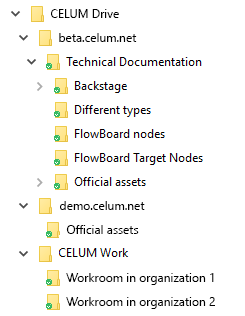
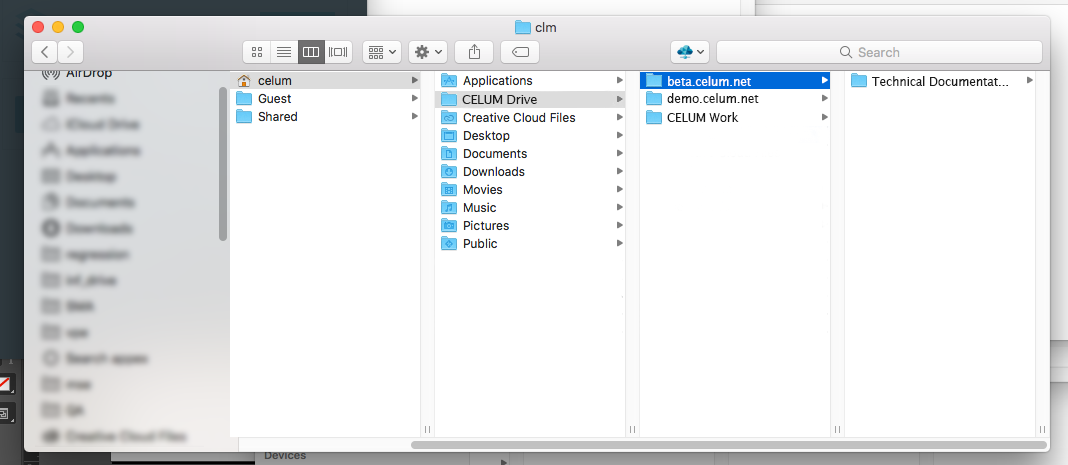
Example CELUM location on Windows® and macOS®
In the below example, the user is connected to two CELUM Content servers as
well as the CELUM Work
browser application, so there are three repository directories
named "beta.celum.net", "demo.celum.net"
and "CELUM Work".
The user has subscribed to the CELUM Content
collection "Technical Documentation" in the "beta.celum.net"
repository. Furthermore, the user has subscribed to two Workrooms in the
CELUM Work application.
 |
 |
What does the
subscribed scopes' structure look like in my local file system?
By default, each subscribed scope is represented by a single flat folder in the CELUM location. This means that no folders are created locally for the CELUM Content child collections or for the CELUM Work subfolders.
If you'd like to have separate folders for CELUM Content child collections, contact the technical administrator of your CELUM Content server so they can change the configuration.